
'The real risk is not that AI will fail to transform India's economy.'
'The risk is that it already is -- while our measurement systems continue to look the other way,' observes Nishant Sahdev, a theoretical physicist at the University of North Carolina.

'There is a challenge in repositioning yourself, maybe reinventing yourself.'

Indian GDP will grow at 8.5 per cent in 2021-22, and the rate will accelerate further to 9.8 per cent in 2022-23, a foreign brokerage said on Tuesday. The GDP had contracted by 7.3 per cent in the pandemic-hit FY21, and is widely expected to grow at a faster pace due to the base effect in 2021-22. The Reserve Bank of India (RBI) expects a 9.5 per cent growth in 2021-22, and the same to slow down to 7.8 per cent as things normalise.

'Credit growth in India remains in double digits, even though corporate borrowing is subdued.' 'Corporate credit is weak because companies are cash-rich and cautious amid global uncertainty.'
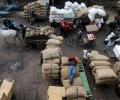
India's economy is expected to grow 6.4-6.7 per cent during the current financial year driven by strong domestic demand, even as geopolitical uncertainty poses downside risks, the newly appointed CII president Rajiv Memani said on Thursday.

China's latest defence budget surges to $275 billion, fueling its ambitious military modernisation program and intensifying geopolitical dynamics in the region.

Government-estimated growth for 2008-09 is 7.1 per cent. However, as per RBI estimates, GDP growth would be around 6 per cent in 2009-10.

The Reserve Bank of India on Friday decided to keep the policy rate unchanged for the 11th time in a row but sharply lowered the GDP growth forecast to 6.6 per cent for the current fiscal, as against earlier projection of 7.2 per cent. The Reserve Bank of India (RBI) maintained the status quo on interest rate despite July-September quarter GDP growth falling to 7-quarter low of 5.4 per cent, as against its own projection of 7 per cent.

Morgan Stanley says, India will clock 7.9 per cent GDP growth in current fiscal.

The CSO said that the first revised estimates for 2016-17 have been compiled using industry-wise/institution-wise detailed information instead of using the benchmark-indicator method employed at the time of release of Provisional Estimates on May 31, 2017.

Asked when the economy will revive, Das said it is difficult to make an estimate as there are many things which are still playing out.
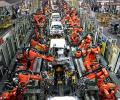
India's economy grew 6.1 per cent in the fourth quarter of 2022-23, pushing up the annual growth rate to 7.2 per cent, official data showed on Wednesday.
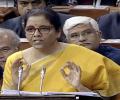
The revised estimated expenditure for FY20 has been pegged at Rs 26.99 lakh crore and receipts at Rs 19.32 lakh crore, she said.

Country's startups are carving a unique path by prioritising local, application-led innovation over the global pursuit of scale.

The Indian economy is growing at a robust pace, driven by strong domestic demand, low inflation, and the healthy balance sheets of banks, said a Reserve Bank report released on Wednesday.

The cost of the war is being counted not in the corridors of power in Washington or Tehran, but in Firozabad's darkened furnace rooms, Howrah's idle casting sheds, and a barbershop in Kochi where the wait is suddenly, inexplicably, an hour long, notes Prem Panicker in his must read blog on the Iran War.

The July-September quarter GDP numbers are due on November 30.

From the Sensex firms, State Bank of India, Bajaj Finserv, Bajaj Finance, Maruti, HCL Tech, Larsen & Toubro, Mahindra & Mahindra and Infosys were among the major winners. However, Hindustan Unilever, Eternal, Tata Motors Passenger Vehicles, and Sun Pharma were among the laggards.
Moody's Investors Service on Friday slashed its estimate of India's GDP growth during the 2020 calendar year to 2.5 per cent from an earlier estimate of 5.3 per cent, on account of the rising economic cost of the coronavirus pandemic.

The U.S. economy grew faster than initially thought in the second quarter.
Demonetisation to result in short-run disruptions in cash-intensive sectors like retail, hotels, restaurants and transportation, RBI said while announcing the Monetary Policy

Gold prices are expected to remain volatile next week as investors track geopolitical developments in the Middle East and key macroeconomic data releases that could shape the sentiment in the domestic market, analysts said.
Further, the agency said it expects signs of a pick-up to emerge in the second half of the year.
Economic think-tank National Council of Applied Economic Research expects India's Gross Domestic Product growth to decelerate to 8.3 per cent during current fiscal

India's real GDP grew 8.2 percent in the second quarter of 2025-26, up from 7.8 percent in the first quarter and 7.4 percent in the fourth quarter of the last fiscal.

There are some apparent paradoxes visible in the data from the first quarter of 2025-26 (Q1FY26). The gross domestic product (GDP) delivered a positive surprise with 7.8 per cent year-on-year (Y-o-Y) growth.

The Swadeshi Jagran Manch (SJM) is advocating for the termination of the moratorium on customs duties for electronically transmitted digital products, arguing that it hinders self-reliance, causes revenue losses, and restricts India's ability to tax emerging technologies like AI.
The Indian economy grew by 4.5 per cent in the October-December period of the current financial year, pulled down by poor performance of farm, manufacturing and mining sectors.

Budget 2026 is an intentional and ambitious one - From manufacturing growth to services supremacy, from technology consumption to AI-powered transformation. This is the blueprint for a $7 trillion economy built on intelligence, not just scale.

The Asian Development Bank too had projected Indian's economic growth for current fiscal at 7.4 per cent.

The state plans for 4 per cent growth in agriculture and 11 per cent each in industry and services sector.

'Political parties bring out money they have stashed away and start spending it. How large that spending will be depends on how much money has been stashed. So, you are going to have a strong upside coming from the election effect,' says Pronab Sen.

Finance Minister Nirmala Sitharaman on Tuesday participated in a traditional 'halwa' ceremony, marking the final stage for the preparation of the Union Budget 2026-27, to be unveiled on February 1 in the Lok Sabha.

India's manufacturing sector activity witnessed a slight recovery in January, amid faster increase in new orders, even as business confidence slipped to its lowest level in three-and-a-half years, a monthly survey said on Monday.

India's services sector growth witnessed the slowest pace of expansion in five months in October, as competitive pressures and heavy rains in parts of the country led to a slower increase in output, according to a monthly survey released on Thursday.

GST stabilisation, DTC implementation and banking reforms are crucial for sustaining high growth for a long period, says Rashesh Shah.

Geopolitical tensions, trade policy uncertainties, volatility in international commodity prices and financial market uncertainties pose considerable risks to India's economic growth in the coming year, the finance ministry cautioned on Wednesday. "Global trade continues to be affected by uncertainty in the policy environment... tariff-related developments in multiple countries have heightened trade-related risks, affecting investment and trade flows globally.
